
Theme 2
Collaborative Dis(re)assembly
Theme Leads
Dr Yongjing Wang and Professor Duc Trouong Pham
Contact-rich tasks are complex physical interactions with the environment requiring precise force/motion control, like peg-in-hole or assembly, involving continuous contact dynamics such as sticking or sliding. Currently, the use of robots in this area is limited – tasks that involve complex shapes, small clearances or deformable materials are particularly challenging to robotise due to the likelihood of jamming and wedging. However, easy automation and up-scaling of contact-rich tasks are key for cost-effective advancement of circular manufacturing processes. Considerations for developing capabilities to overcome such challenges are reflected in the research themes within the RESCu-M2 hub, with Theme 2 – Collaborative Dis(re)assembly leading the way.
Scientific Scope of Work
This research theme aims to design flexible, modular, cross-sector equipment for collaborative disassembly/reassembly of products varying in size, weight, material, and conditions (for example electric vehicle drive motors, power electronics, batteries and water pumps). Within this, there is a focus on the component level for their retrieval, assessment, reuse and remanufacturing. Creating collaborative disassembly and reassembly requires addressing the challenges in both hardware (sensors, actuators, compliance devices) and software (task generalisation, decision making, and system robustness).
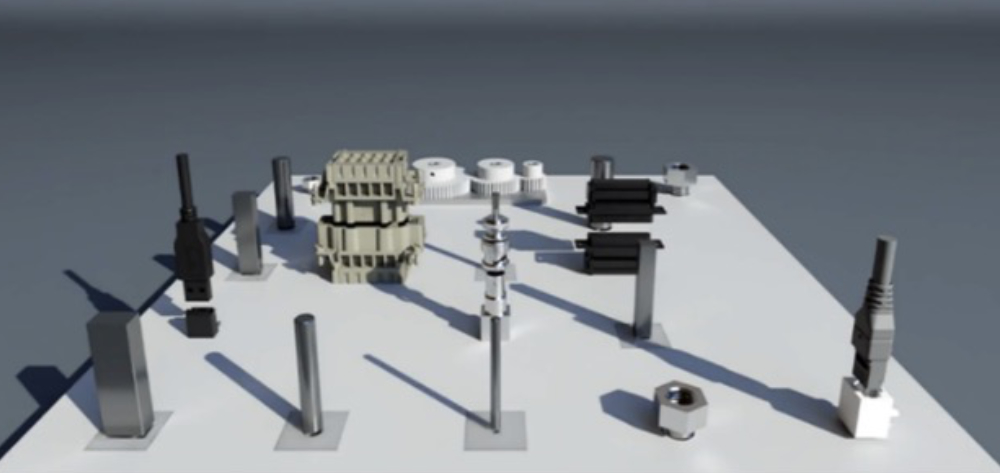
Many assembly and disassembly tasks in manufacturing occur in environments with limited accessibility, such as shaft-hole insertion/separation and bolt-nut assembly/disassembly. Using robots to complete these contact-rich tasks is more complicated than those having no physical contacts (e.g. computer visual inspection) or simple contacts (e.g. cutting, welding, pick-and-place). Some examples of contact-rich tasks in manufacturing include:
- a robot removing a nut from a bolt;
- nut-bolt interactions involving multiple contact points and complex force conditions which can lead to jamming and wedging and;
- peg-hole tasks, shaft-ring tasks, gear-gear tasks, and socket-plug tasks.
Research questions
How can the robotic assembly/disassembly skills be generalised and augmented? How do we transfer the skill between machines and how can contact-rich skills be applied to a variety of tasks?
How can a robot collect information during disassembly and analyse end-of-life data to identify patterns that support decision-making?
Get in touch
Write us an email at [email protected]