
Flagship 4
LARGE STRUCTURES
Flagship lead
Professor Ashutosh Tiwari (University of Sheffield)
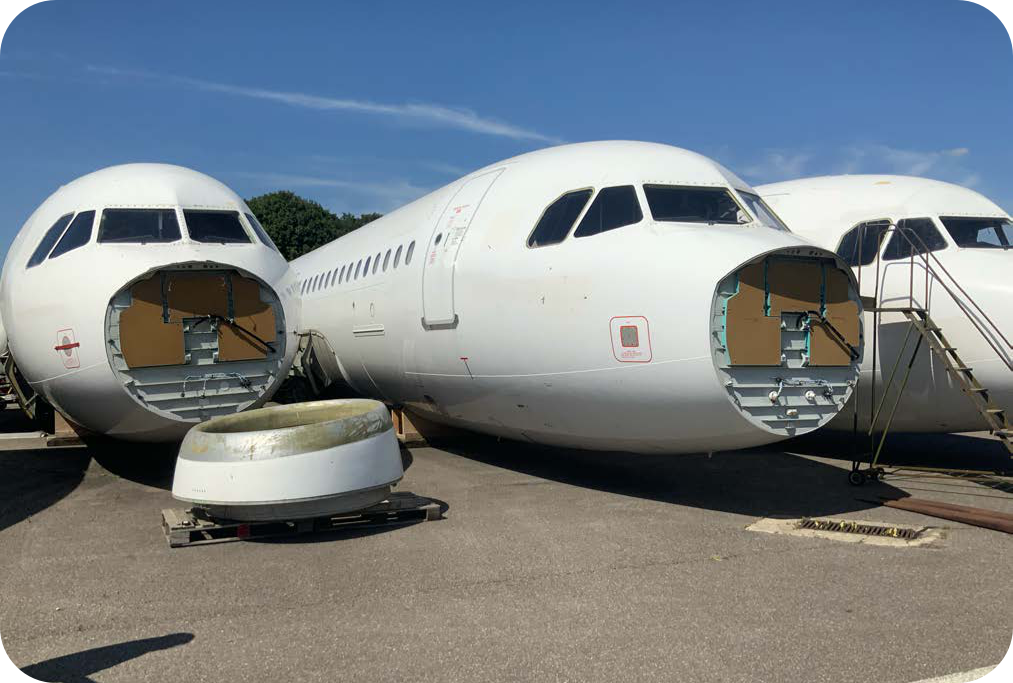

Challenges in aerospace disassembly of high-value aircraft components and wind turbine aerostructures contain a high degree of geometric variations and composite components. The Large Structures flagship advances technical capacities for these challenges as it tackles the end-of-life stage for the world’s biggest engineered assets: commercial aircraft, wind-turbine blades and other large composite or metallic structures. Its goal is to turn retirement into a high-value, data driven circular supply chain that:
- Feeds certified Used Serviceable Material (USM) straight back into aerospace and energy markets
- Recovers critical minerals for next-generation manufacturing
- Delivers the 10× productivity step-change targeted by the RESCu-M2 Hub
Large, engineered assets such as wide-body aircraft fuselages and 80-metre wind-turbine blades are reaching end-of-life in ever-greater numbers. Each structure locks away tonnes of high-value titanium, aluminium, carbon-fibre and rare-earth magnets, yet today most retirements rely on slow, manual strip-down or landfilling. The result is a costly bottleneck for the fast-growing Used Serviceable Material market in aerospace and an emerging waste crisis in renewable energy, the very moment both sectors are scrambling for secure, low-carbon supplies of critical minerals. Manual disassembly also drives up labour demand: current remanufacturing tasks are already three-to-six times more labour-intensive than forward production, a gap the UK cannot close without new technology.
Converting this liability into a resource stream demands a leap in smart automation. Working with stakeholders like Air Salvage International (ASI) a UK-based aircraft disassembly and MRO business has brought to light many challenges in this domain. Large structures arrive in unpredictable states, for example, hidden fasteners, mixed composites, residual fuels or resins, and today’s ad-hoc, siloed Re-X systems lack the flexible robotics, real-time data and decision support to cope. High-payload robots must collaborate safely with people, “digital passports” and live sensor feeds have to converge in trustworthy digital twins to guide end-of-life processes, and AI-driven grading plus rapid certification are needed so reclaimed parts can re-enter global supply chains at scale. Meeting these challenges is central to the Large-Structure Flagship, which aims to translate UK excellence in AI, robotics and circular engineering into a productive, low-carbon end-of-life pathway for aerospace, wind energy and the broader family of oversized assets.
Get in touch
Write us an email at [email protected] or fill in the form below.