
Flagship 1
ENERGY
Flagship leads
Nuclear – Professor Moataz Attallah (Loughborough University)
Batteries – Professor Emma Kendrick (University of Birmingham)
Next-generation energy technologies such as nuclear fusion, small modular reactors (SMRs), and advanced modular reactors (AMRs) employ substantial quantities of high-value functional and structural materials with significant potential for recycling and resource recovery. These systems incorporate nickel, molybdenum, niobium, tungsten, copper-based alloys, zirconium alloys, advanced steels, and depleted uranium shielding, which are extensively used in pressure vessels, first-wall assemblies, heat exchangers, superconducting coils, and radiation shields. Following safe decontamination, many of these materials can be reclaimed, reprocessed, and reintegrated into new energy systems. Moreover, the modular and compact architectures of SMRs and AMRs facilitate disassembly, component reuse, and targeted recovery of critical elements, thereby advancing a circular materials economy within the nuclear energy sector.
Challenges
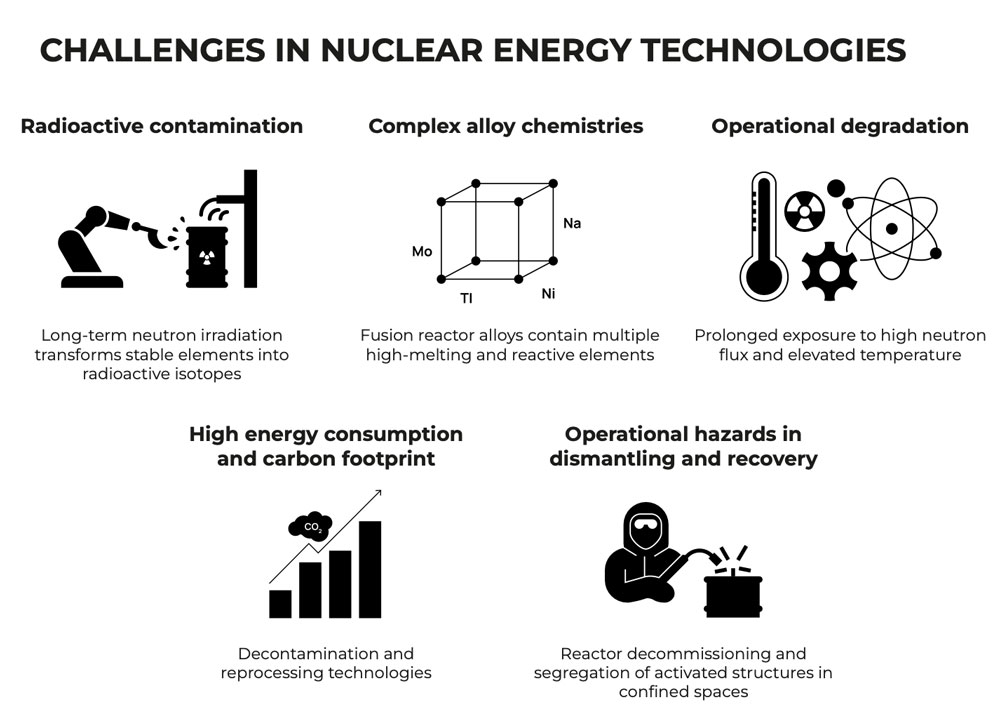
Radioactive contamination
Neutron irradiation makes nuclear components radioactive for decades, requiring remote handling by robots. However, the intense radiation itself damages robot electronics and weakens their mechanical parts, compromising safety and performance.
Operational degradation
Prolonged neutron exposure causes material’s swelling, phase instability and embrittlement, which alter mechanical and magnetic/electrical properties. These make direct reuse of components unsafe, requiring reprocessing or downcycling rather than true recycling.
Complex alloy chemistries
The complex mix of elements in fusion reactor alloys makes them extremely difficult to recycle. After being exposed to radiation and heat, separating and purifying these elements becomes inefficient, often requiring energy-intensive chemical processes.
High energy consumption and carbon footprint
Current decontamination and reprocessing technologies such as smelting, electro-refining, or chemical leaching consume large amounts of energy and generate secondary waste streams. These processes contribute significantly to greenhouse gas emissions, partially offsetting the environmental gains achieved through low-carbon energy generation.
Operational hazards in dismantling and recovery
Reactor decommissioning requires the remote disassembly of radioactive components in hazardous, confined spaces. This process depends on advanced robotics and automated systems, which are still under development. The extreme conditions challenge safe access, accurate material handling, and efficient waste segregation.
Get in touch
Write us an email at [email protected] or fill in the form below.