Theme 4
Autonomous Material Separation and Recovery
Theme Lead
Dr Steve Davis (University of Birmingham)
This theme addresses the efficient and cost-effective recovery of value from End-of-Life products, with the goal of preserving critical materials and reducing waste. The focus is on adopting the shortest possible circular feedback loops –reusing, repairing, refurbishing, or remanufacturing components whenever feasible, with recycling reserved for parts beyond recovery. Development to date has examined gaps and technical requirements for autonomous robotic sorting and the design of pipelines and platforms for circular processes.
Scientific Scope of Work
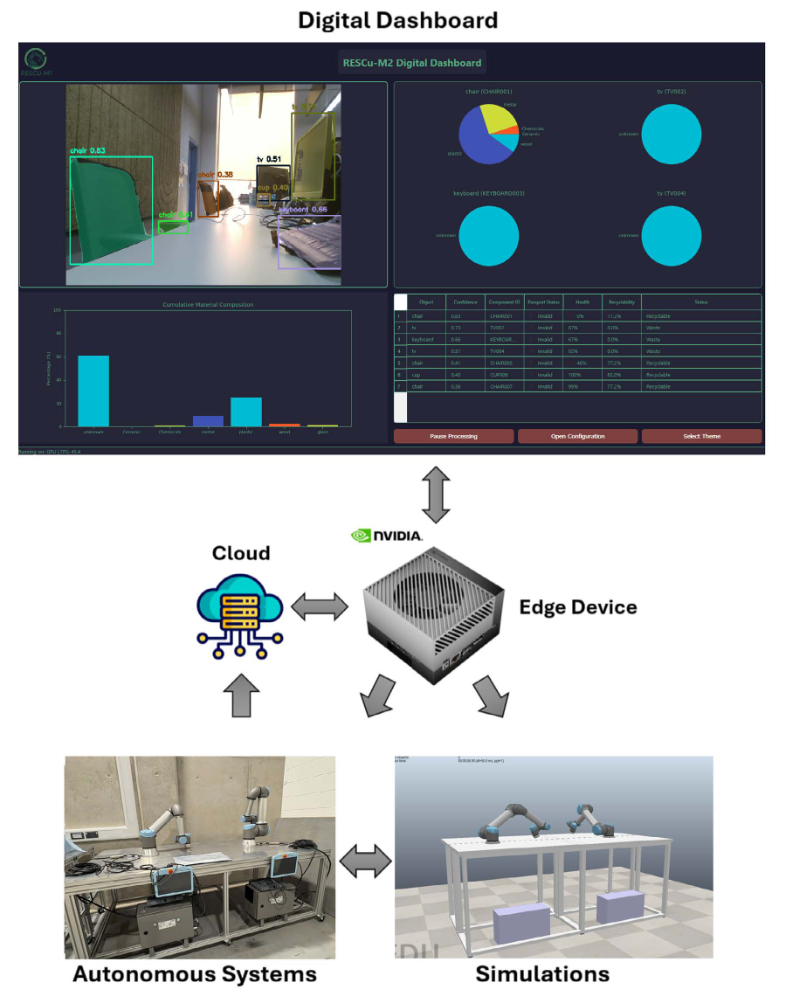
The primary challenge is to replace inefficient, labour-intensive manual sorting methods with robotic, AI-driven, and sensor-enabled solutions. These systems must be intelligent, modular, and adaptable to handle the wide variability of EoL products across sectors. Breakthroughs will require overcoming the high cognitive and motor demands of component sorting. Intelligent platforms capable of interpreting digital product passports (DPPs) and technical specifications will guide optimal Re-X pathways. In parallel, sensor-guided systems will be developed to recover components without relying on DPPs, enabling scalable, precise, and autonomous recovery of critical materials. A prototype digital dashboard has been developed to visualise sensor data and track recovery metrics. The design of an integration pipeline connecting the digital dashboard, cloud and edge devices and robotic actions have been initiated, forming the basis of a modular, scalable platform for autonomous separation and recovery manufacturing.
Research questions
How can integration of product passports and real-time multi-sensor data enhance the accuracy and efficiency of component sorting of EoL products?
How can AI-driven correlation between multisensor condition data and DPPs records enhance condition assessment, guide separation decisions, and support optimal Re-X pathway selection for EoL components?
How can modular, digital-twinenabled autonomous systems recover valuable components from heterogeneous EoL products, while tracking material yield, energy use, and cross-sector performance?
Get in touch
Write us an email at [email protected]